What Is a Next-Generation Firewall (NGFW)?
A next-generation firewall (NGFW) is an advanced network security solution that inspects and controls traffic at a deeper level than traditional firewalls. Instead of relying only on ports, protocols, and IP addresses, an NGFW uses deep packet inspection (DPI) to analyze packet contents, recognizes specific applications, and applies policies based on users and behaviors.
Modern networks rely on cloud applications, encrypted traffic, and remote access, which makes basic packet filtering insufficient. By combining intrusion prevention, application control, and real-time threat detection in a single platform, a next-generation firewall delivers stronger visibility and more precise enforcement across the entire network.
What Created the Need for NGFWs?
The need for next-generation firewalls arose with changes in how networks operate – and how attackers exploit them. Traditional firewalls were built for simpler environments, where applications were predictable and most attacks targeted the network layer.
As organizations adopted web-based apps, SaaS, cloud services, mobile devices, and encrypted communication, attackers began exploiting application-layer vulnerabilities and hiding malicious payloads inside seemingly legitimate traffic. Because legacy firewalls could not reliably identify applications, inspect encrypted flows, or detect sophisticated exploits, organizations needed a more intelligent, context-aware security control – leading to the development of NGFWs.
Traditional vs. Next-Generation Firewalls: A Fundamental Shift in Security
Traditional firewalls focus on “where” traffic is going: IP address, port, and protocol. This worked when threats were simpler and applications followed fixed patterns.
Next-generation firewalls (NGFWs) add the ability to understand “what” the traffic actually is:
- Which application is in use
- Which user or device is generating the traffic
- Whether the content is safe, suspicious, or malicious
They integrate intrusion prevention, threat intelligence, and encrypted traffic inspection, allowing organizations to detect modern threats, control risky applications, and deliver far more precise firewall protection than previous firewall generations.
What Are the Limitations of Traditional Firewalls?
Traditional firewalls were not designed for today’s application-heavy, encrypted, and cloud-centric networks. Key limitations include:
- No application awareness: They see ports and protocols, not specific apps, making it easy to hide attacks in allowed traffic.
- Limited encrypted traffic visibility: They usually cannot inspect TLS/SSL payloads, missing threats inside encrypted sessions.
- Static rule sets: They lack built-in threat intelligence or behavior analysis, making them weak against zero-day or evasive attacks.
Because of these gaps, legacy firewalls struggle to secure environments that rely on cloud apps, APIs, remote access, and distributed workloads.
What Are the Differences Between NGFWs and Traditional Firewalls?
The core differences between traditional firewalls and NGFWs can be summarized as:
| Aspect | Traditional Firewall | Next-Generation Firewall (NGFW) |
| Inspection Depth | Header-level only (IP, port, protocol) | Full packet contents, including application data |
| Context | Network context only | Application, user, device, and behavior context |
| Security Functions | Basic access control | Integrated IPS, application control, threat intelligence, sandboxing, and SSL inspection |
Core Features and Capabilities of a Modern NGFW
A modern next-generation firewall (NGFW) provides far deeper visibility and control than a traditional firewall. At a high level, its purpose is to identify what traffic actually is, who it belongs to, and whether it is safe. Core capabilities include application-level awareness, user-based policy control, and advanced inspection methods that go beyond basic IP/port rules.
This section introduces the foundational concepts behind NGFW functionality – how these firewalls examine traffic, understand context, and enable consistent protection across cloud, on-premises, and hybrid networks.
Modern NGFW Features
Modern NGFWs build on those core concepts with advanced, feature-rich capabilities that provide precise, adaptive security. Key features include:
- Application Awareness & Control: Identify and manage applications regardless of port or protocol.
- Deep Packet Inspection (DPI): Detect hidden malware, exploits, or C2 activity.
- Integrated Intrusion Prevention (IPS): Block known vulnerabilities and suspicious patterns.
- Encrypted Traffic Inspection: Decrypt, inspect, and re-encrypt SSL/TLS traffic.
- User Identity Integration: Apply policies based on AD, SSO, or IAM identities.
- Threat Intelligence Feeds: Continuously update blocklists and detection logic.
- Sandboxing & Malware Analysis: Execute suspicious files safely to identify zero-day threats.
- Automation & Orchestration: Push rules and updates across distributed environments.
- Visibility & Analytics: Monitor applications, risks, and traffic patterns in real time.
These advanced features enable NGFWs to function as adaptive, context-aware security platforms, far beyond what traditional firewalls can offer.
Deep Packet Inspection and Application Control
Two defining capabilities of a next-generation firewall (NGFW) are deep packet inspection (DPI) and application control.
- DPI looks beyond headers and analyzes the packet payload. It can identify malware, exploit code, data exfiltration, and other malicious content hidden inside legitimate flows.
- Application control identifies specific apps (even when they use non-standard ports or encryption) and applies policies per application or app category.
Together, these functions give security teams precise control over what runs on the network and the ability to block threats that traditional firewalls would never see.
What Are Packet Filtering and Deep Packet Inspection (DPI)?
Packet filtering and deep packet inspection represent two different generations of firewall analysis techniques. Understanding the distinction helps illustrate how next-generation firewalls (NGFWs) evolved from basic traffic control to advanced, application-aware security.
Packet Filtering
Packet filtering is the simplest and earliest firewall technique. It examines only the header information of a packet – such as the source IP, destination IP, port, and protocol – to determine whether to allow or block the traffic. While fast and lightweight, packet filtering cannot see inside the packet itself, making it ineffective against modern threats that hide malicious payloads inside seemingly legitimate connections.

Packet filtering (basic header inspection)
Deep Packet Inspection (DPI)
Deep packet inspection goes much further by analyzing the actual contents of the packet. DPI evaluates application data, embedded commands, payload patterns, and behavior indicators to detect malware, exploits, tunneling attempts, and other hidden threats. This granular visibility is a core component of NGFW security, enabling context-aware decisions that traditional firewalls cannot make.

Deep packet inspection (DPI – advanced payload analysis)
What Capabilities Does an NGFW Have?
A next-generation firewall (NGFW) brings its core features together into coordinated, real-world security functions. Instead of focusing on individual tools, this section summarizes how an NGFW uses those tools to protect the network:
- Understand and regulate traffic context: Next-gen firewalls correlate applications, users, devices, and behavior to enforce policies with greater precision than traditional firewalls.
- Perform multi-layer threat analysis: By combining DPI, IPS, and threat intelligence, NGFWs evaluate traffic for exploits, malware, and anomalies in real time.
- Secure encrypted communication: When allowed by policy, NGFWs decrypt SSL/TLS traffic, inspect it for hidden threats, and re-encrypt it without disrupting workflows.
- Enforce identity-based access: Integrations with AD, SSO, and IAM help apply role-based policies across on-premises, cloud, and remote environments.
- Provide unified visibility: NGFWs centralize insights into applications, risks, and traffic flows, helping teams detect suspicious patterns and maintain compliance.
- Automate policy and rule updates: Dynamic adjustments based on new threats or changing application behavior keep protection current without constant manual intervention.
Together, these capabilities enable an NGFW to function as a central enforcement point, coordinating threat detection, access control, and visibility across modern, distributed networks.
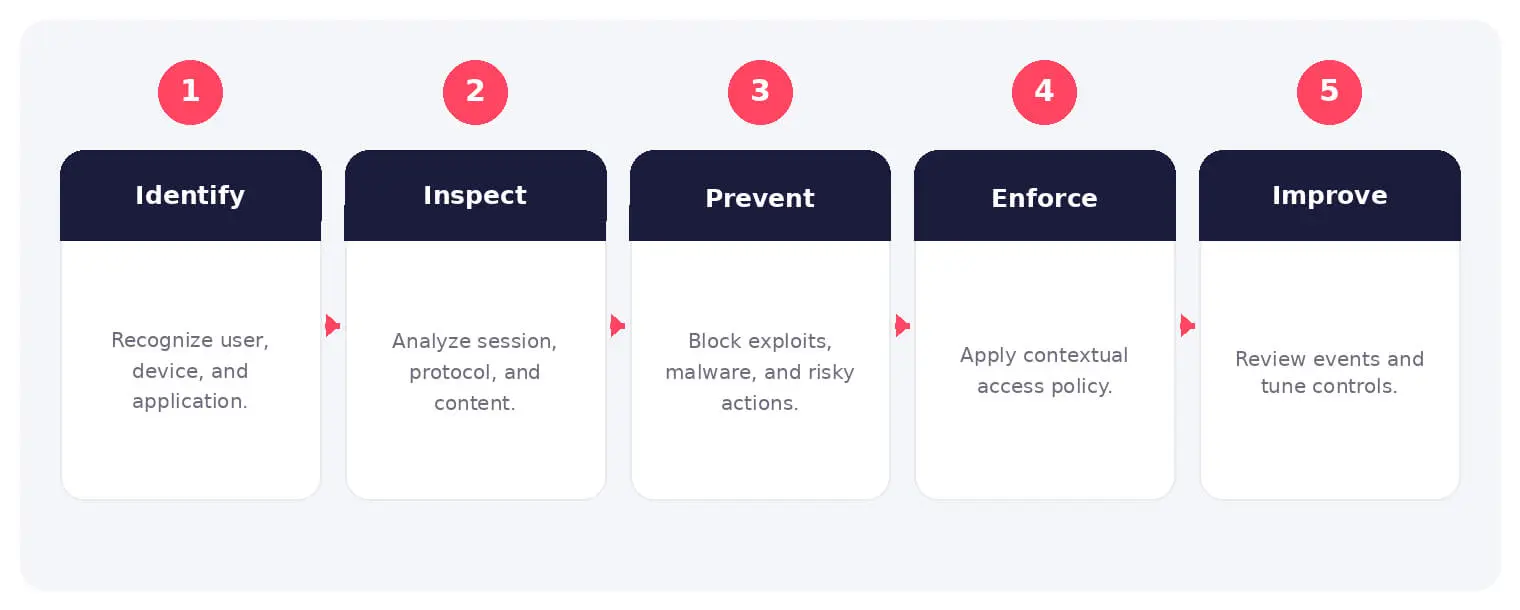
How Does an NGFW Work?
A next-gen firewall evaluates each connection using multiple layers of context:
- Identify the application and user – regardless of port or encryption.
- Analyze contents with DPI – inspect payloads for malware, exploits, or sensitive data.
- Apply IPS and threat intelligence – compare traffic against signatures and behavioral indicators.
- Inspect encrypted traffic (if enabled) – decrypt, analyze, and re-encrypt SSL/TLS flows.
- Enforce policy – allow, block, log, or trigger automated responses based on risk.
By combining these steps, next-generation firewalls provide real-time, application-level protection across on-premises, cloud, and hybrid environments.
What Are the Most Common NGFW Misconceptions?
Several misconceptions often surround next-generation firewalls:
- “It’s just a firewall with extra features.” – In reality, NGFWs are built around application, user, and content awareness, which changes how traffic is analyzed and controlled.
- “An NGFW replaces other security tools.” – NGFWs complement, not replace, endpoint security, SIEM/SOAR, or WAFs. They secure network traffic but do not cover every layer.
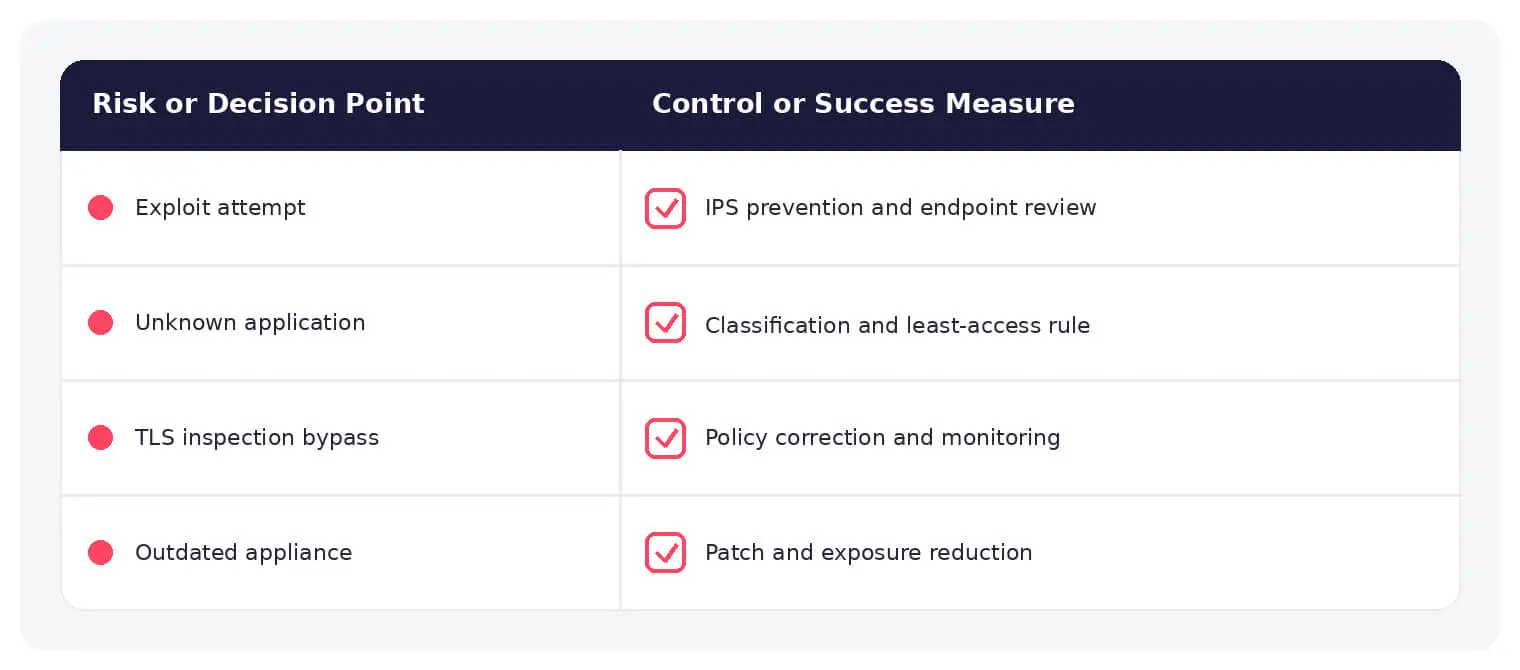
- “Enabling every feature guarantees security.” – Poor tuning, misconfigurations, and lack of SSL inspection can still leave gaps. Policy design and maintenance remain critical.
- “NGFWs always slow down the network.” – Deep inspection has a cost, but modern NGFWs use optimized engines and hardware acceleration to minimize impact when properly sized and configured.
What Are the Features of an NGFW?
While vendors differ in naming and implementation, the features of a next-generation firewall (NGFW) can be grouped into a few core categories. Rather than listing individual tools already covered in earlier sections, this part highlights the functional families that define NGFW technology:
- Traffic Intelligence & Application Awareness: NGFWs classify traffic based on the actual application and user, enabling granular control that goes far beyond IP/port filtering.
- Threat Prevention & Detection: This includes integrated IPS, behavior analysis, and mechanisms for identifying malicious content or activity before it reaches critical systems.
- Encrypted Traffic Handling: NGFWs can safely process SSL/TLS traffic – decrypting, inspecting, and re-encrypting it where policy allows – to uncover threats hidden in encrypted channels.
- Adaptive & Automated Security Policies: Policies can adjust dynamically based on risk, identity, application behavior, or threat-intelligence updates, reducing manual overhead.
- Unified Visibility Across Environments: NGFWs provide consistent inspection and policy enforcement across physical appliances, virtual deployments, and multi-cloud environments, centralizing visibility into traffic and risk.
Grouped this way, next-gen firewall features function as a coordinated security layer that adapts to changing workloads, helps prevent modern attacks, and maintains strong protection across distributed networks.
How Do NGFWs Compare with Other Security Technologies?
NGFWs sit at the network boundary and focus on inspecting and controlling traffic, but other tools protect different layers:
- IDS/IPS: NGFWs often integrate IPS, but standalone IDS/IPS may still monitor deeper inside the network.
- WAF: A web application firewall protects specific web apps and APIs at the HTTP layer, while an NGFW secures broader network and application traffic.
- SWG / CASB: Secure web gateways and CASBs focus on outbound user traffic and SaaS usage; NGFWs emphasize inbound and east–west flows.
- Endpoint protection (EPP/EDR): Secures devices themselves, whereas NGFWs secure network communications.
- UTM: Unified threat management bundles multiple controls for small environments; NGFWs provide more scalable, enterprise-grade inspection and analytics.
NGFWs are most effective as part of a layered, integrated defense strategy.
What to Look for in an NGFW Solution
When evaluating a next-generation firewall, organizations should prioritize:
- Visibility: Application, user, and encrypted traffic visibility.
- Prevention accuracy: Strong IPS and DPI engines with low false positives.
- Encrypted traffic support: Efficient SSL/TLS inspection at scale.
- Consistency: Same security stack across appliances, virtual machines, and cloud deployments.
- Integrations: Support for identity providers, SIEM/SOAR, and threat intelligence.
- Manageability: Centralized dashboards, automation, and clear policy workflows.
- Performance and scalability: Ability to handle current and future traffic loads without major latency.
These factors ensure the NGFW can adapt to evolving threats and architectures.
Choosing the Right NGFW: Key Considerations
The right NGFW should integrate smoothly into your existing security stack, support growth, and remain manageable over time. Consider:
- Architecture: Do you primarily operate on-premises, in the cloud, or across hybrid and multi-cloud environments?
- Traffic patterns: How much encrypted traffic do you handle, and where are the main inspection points?
- Policy consistency: Can the NGFW enforce unified rules across all locations without multiple consoles?
- Licensing and TCO: Understand costs tied to throughput, users, or feature tiers, as well as support and maintenance.
- Vendor maturity: Look at update frequency, threat-intelligence quality, and roadmap stability.
How to Successfully Deploy NGFWs
A successful NGFW deployment involves planning, staging, and ongoing tuning:
- Map traffic and dependencies: Understand key applications, users, and data flows.
- Start in monitor mode: Observe traffic and adjust application/identity policies before full enforcement.
- Clean up legacy rules: Remove unused or overly permissive rules to avoid conflicts and blind spots.
- Test performance: Validate inspection (including SSL) under realistic loads and adjust architecture if needed.
- Integrate with existing tools: Connect to identity providers, SIEM/SOAR, and endpoint security.
- Review and refine regularly: Update policies, review logs, and apply new threat intelligence on an ongoing basis.
This approach reduces disruption while maximizing the accuracy and value of the next-gen firewall.
Why an NGFW is Crucial for Your Organization
For organizations facing modern threats, an NGFW is no longer optional. Traditional perimeter defenses cannot keep up with application-layer attacks, encrypted malware, and evasive techniques. NGFWs provide the real-time visibility and control needed to detect and block these threats before they reach critical systems.
They also ensure consistent, application-aware policies across on-premises, multi-cloud, and virtualized environments, reducing blind spots and supporting zero-trust initiatives. By consolidating capabilities like IPS, threat prevention, and identity-aware control, NGFWs help reduce tool sprawl and simplify operations while strengthening overall resilience.
Frequently Asked Questions (FAQs)
Q1: Do NGFWs replace IDS/IPS or endpoint security tools?
A: No. While NGFWs integrate intrusion prevention and offer strong network-layer visibility, they do not replace endpoint detection, SIEM/SOAR platforms, or web application firewalls. They complement these tools by providing enforcement at the network boundary.
Q2: Does enabling all NGFW features slow down network performance?
A: NGFWs perform resource-intensive inspections, especially with SSL/TLS decryption. Modern solutions use hardware acceleration and optimized engines to reduce performance impact. Proper tuning ensures strong security without unnecessary latency.
Q3: Do NGFWs protect cloud and hybrid environments?
A: Yes. Many NGFWs support virtualized and cloud-native deployments, offering consistent policies across on-premises, multi-cloud, and hybrid networks. They help secure cloud workloads and inspect traffic east–west within virtual environments.
Q4: What should organizations look for when evaluating NGFWs?
A: Key considerations include application visibility, IPS accuracy, encrypted traffic inspection, threat intelligence integration, scalability, performance under load, and ease of policy management.
Q5: How often should NGFW policies be reviewed or updated?
A: Policies should be reviewed regularly (typically monthly or quarterly) and whenever new applications, cloud services, or business requirements are introduced. Frequent updates ensure effective protection and reduce misconfiguration risk.