




Jul 31, 2026

Table Of Content
Top 10 Free IoC Search & Enrichment Platforms
What Are Indicators of Compromise (IoCs)?
1. AlienVault Open Threat Exchange (OTX)
2. Pulsedive
3. AbuseIPDB
4. ThreatMiner
5. IOC Radar by SOCRadar Labs
6. ThreatFox & URLhaus (by abuse.ch)
7. GreyNoise
8. MISP Threat Sharing
9. VirusTotal
10. ThreatBook
Other Notable Platforms with Free Access
Bonus: SOCRadar Threat Feed & IoC Module
Related Articles

Top 10 MSSPs in Belgium (2026)

Cyber Risks for Wearable Technologies
Jul 27, 2026


Top 10 MSSPs in the UK in 2026
Jul 17, 2026
SOCRadar XTI Is Live on the Chrome Web Store
Jul 16, 2026

Jul 01, 2025
16 Mins Read

Top 10 Free IoC Search & Enrichment Platforms
Indicators of Compromise (IoCs) are digital clues that help identify malicious activity in an endpoint or network. They serve as the foundation for threat detection and incident response, helping security teams trace the signs of data breaches, malware infections, or targeted attacks.
IoCs are typically extracted from malware samples, network logs, or intrusion analysis. Security teams use them in firewalls, SIEMs, and other tools to detect threats in real-time or investigate past incidents. From blocking malicious IPs to enriching detection rules, IoCs play a key role in both proactive and reactive cybersecurity strategies.
As threats grow more complex and fast-moving, open access to accurate and enriched IoC data becomes even more essential. Fortunately, several platforms offer free search and enrichment capabilities, letting analysts pivot from a single indicator to a broader threat context.
This blog highlights 10 of the best free platforms for IoC search and enrichment. Each offers unique strengths, from API integrations and malware telemetry to community-driven updates, and can support everything from day-to-day SOC operations to more advanced threat hunting.
What Are Indicators of Compromise (IoCs)?
Common types of IoCs include:
- IP addresses used in command-and-control communications
- Domain names linked to phishing or malware campaigns
- File hashes (MD5, SHA1, SHA256) identifying known malicious files
- Email addresses, URLs, and registry keys used in exploits
- SSL certificates associated with threat actor infrastructure
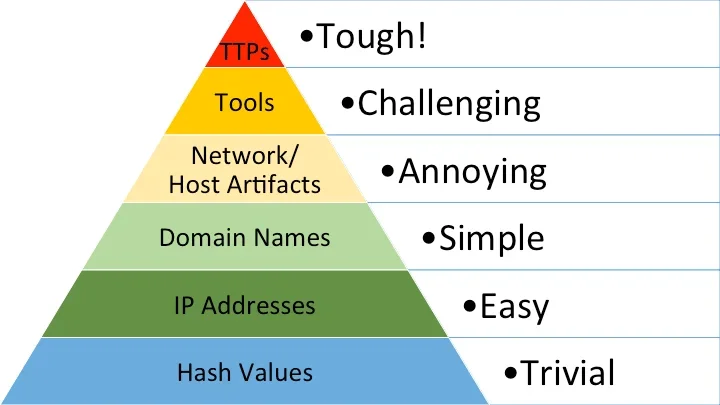
Pyramid of pain showing IoC types (Image)
By analyzing IoCs, organizations can better understand attacker tactics and respond more effectively. These indicators are used to detect threats, investigate incidents, and block malicious activity through tools like SIEMs, firewalls, and EDRs. They also support threat hunting by helping analysts trace attacker behavior. Often shared across the cybersecurity community, IoCs strengthen collective defense and speed up early detection.
With that in mind, let’s now explore the most widely used free platforms that help analysts search, enrich, and pivot around IoCs, each offering unique capabilities for everything from quick triage to deeper threat investigations.

1. AlienVault Open Threat Exchange (OTX)
AlienVault OTX is one of the most popular community-powered threat intelligence platforms available for free. It allows users to search and share IoCs, monitor threat trends, and integrate real-time data into their security tools.
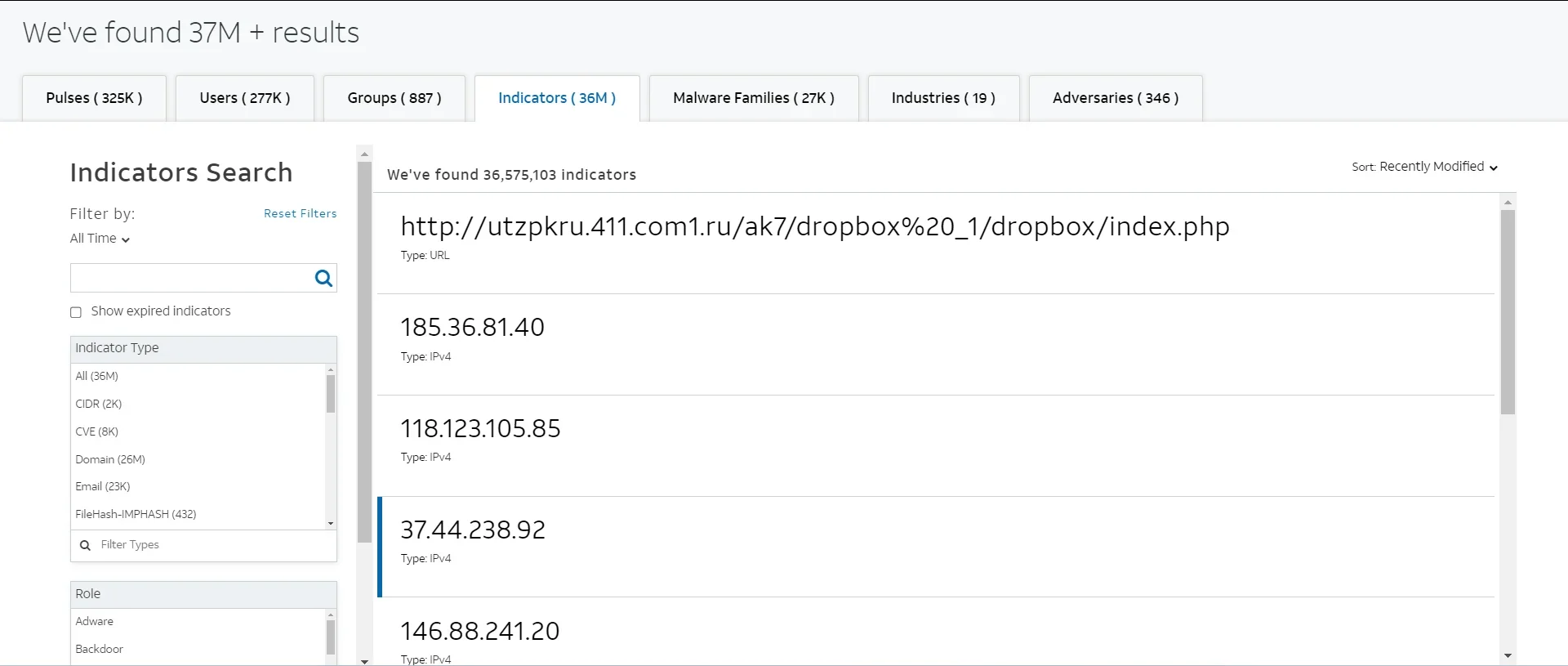
AlienVault Open Threat Exchange Indicators Search
A key feature of OTX is Pulses – community-contributed threat summaries that package IoCs with context, helping analysts track campaigns, malware, and attacker infrastructure. With over 19 million new IoCs processed daily, the platform provides timely, actionable intelligence.
AlienVault OTX supports API integration, allowing for easy automation. Security tools like Suricata can ingest OTX threat feeds to boost detection capabilities. Its API can be accessed using a simple CLI command:
curl /api/v1/pulses/subscribed?page=1 -H “X-OTX-API-KEY: <INSERT_USER_API_KEY>”
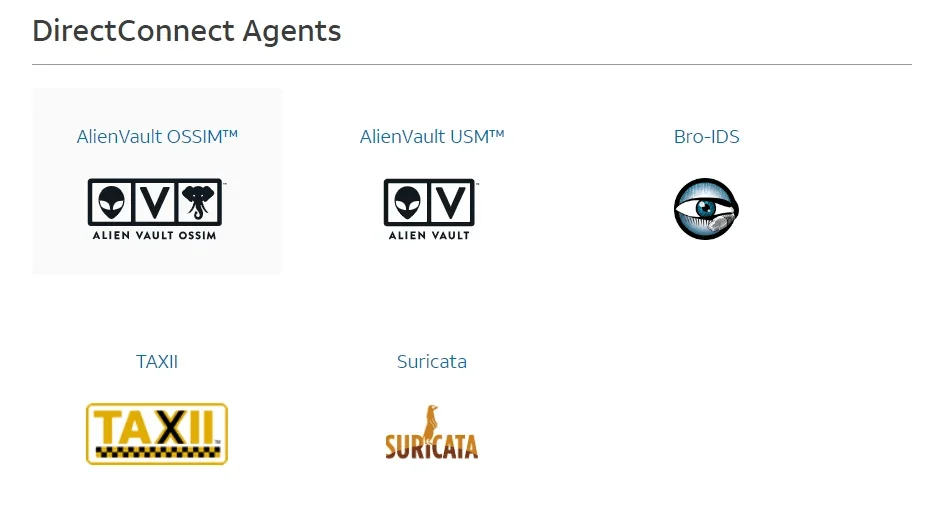
Popular tool, Suricata is also among the Direct Connection Agents
Thanks to its user-friendly interface, active community, and wide data coverage, OTX remains a go-to platform for SOC analysts and researchers looking to enrich or validate IoCs quickly.
2. Pulsedive
Pulsedive is a free threat intelligence platform that collects and enriches millions of IPs, domains, and URLs from global feeds and user submissions. Each indicator is scanned and contextualized, allowing analysts to understand threats without navigating multiple sources.
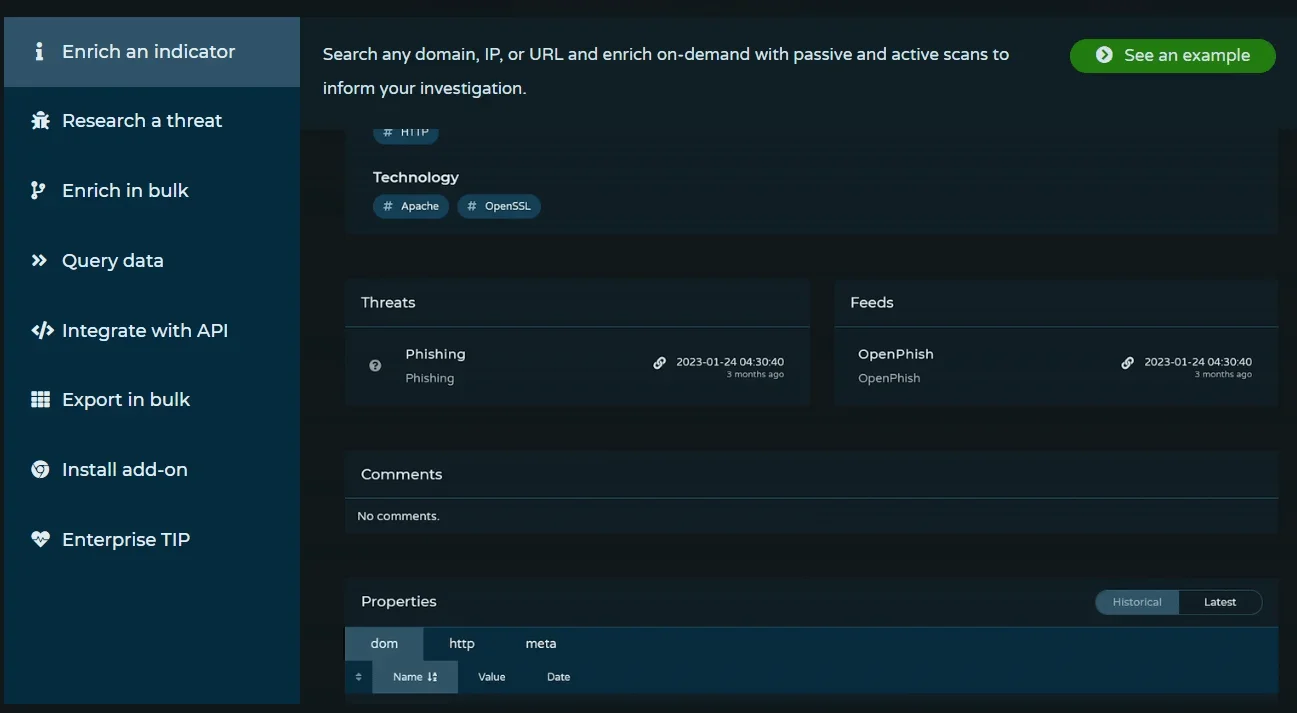
Pulsedive, enriching an indicator
Users can run both active and passive scans, with the option to avoid storing sensitive IoCs unless they choose to submit them. This privacy-conscious design is ideal for organizations that want flexibility in how they interact with the platform.
Enrichment is performed through distributed nodes, reducing exposure when investigating malicious indicators. Pulsedive’s interface is entirely API-driven, so users can automate most actions and integrate threat intelligence into their own tools.
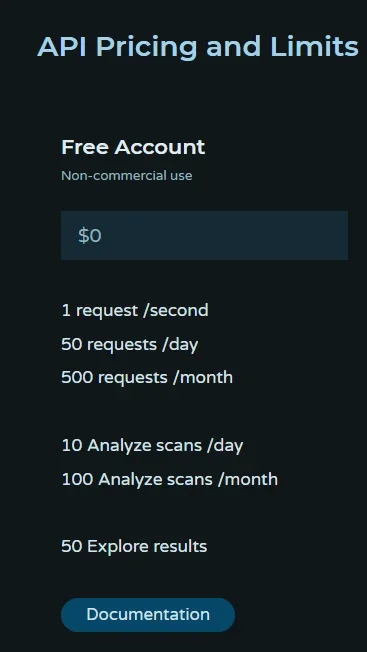
API Pricing for Pulsedive
The free tier is generous and supports non-commercial usage without heavy limitations.
3. AbuseIPDB
AbuseIPDB focuses on a single type of IoC – IP addresses – but it does this exceptionally well. It allows users to report, check, and investigate IPs associated with abuse, spam, hacking, and other malicious behavior. Their goal is to contribute to a safer online environment by offering a centralized blacklist.
This platform serves webmasters, system administrators, and individuals interested in reporting or identifying IP addresses linked to malicious activities online.
The platform is powered by community reports, which helps generate live abuse statistics and insights into attack origins. One useful feature is a global map and table view that highlights which locations are being targeted, all built from organic user submissions.

AbuseIPDB’s most widely reported IPs & attack targets map
Users can either report an IP address associated with malicious activities or verify if an IP address has been reported using the platform’s search. Of course, AbuseIPDB also supports API access for automation and integrates with many common security tools, making it a helpful resource for SOC teams and network admins.
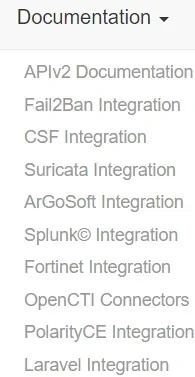
Integration with many popular tools and platforms for blue teams
The free API plan for individual use allows up to 1,000 IP checks per day, which is enough for most small-to-medium security operations.
4. ThreatMiner
ThreatMiner is a free, open-source threat intelligence portal that simplifies Indicator of Compromise (IoC) research by aggregating data from multiple OSINT feeds. It supports searching IPs, domains, file hashes, URLs, SSL certificates, and WHOIS records all in one place.
What makes ThreatMiner very useful is its contextual information, helping analysts understand connections between indicators, associated malware, and threat actor infrastructure rather than just presenting raw data.
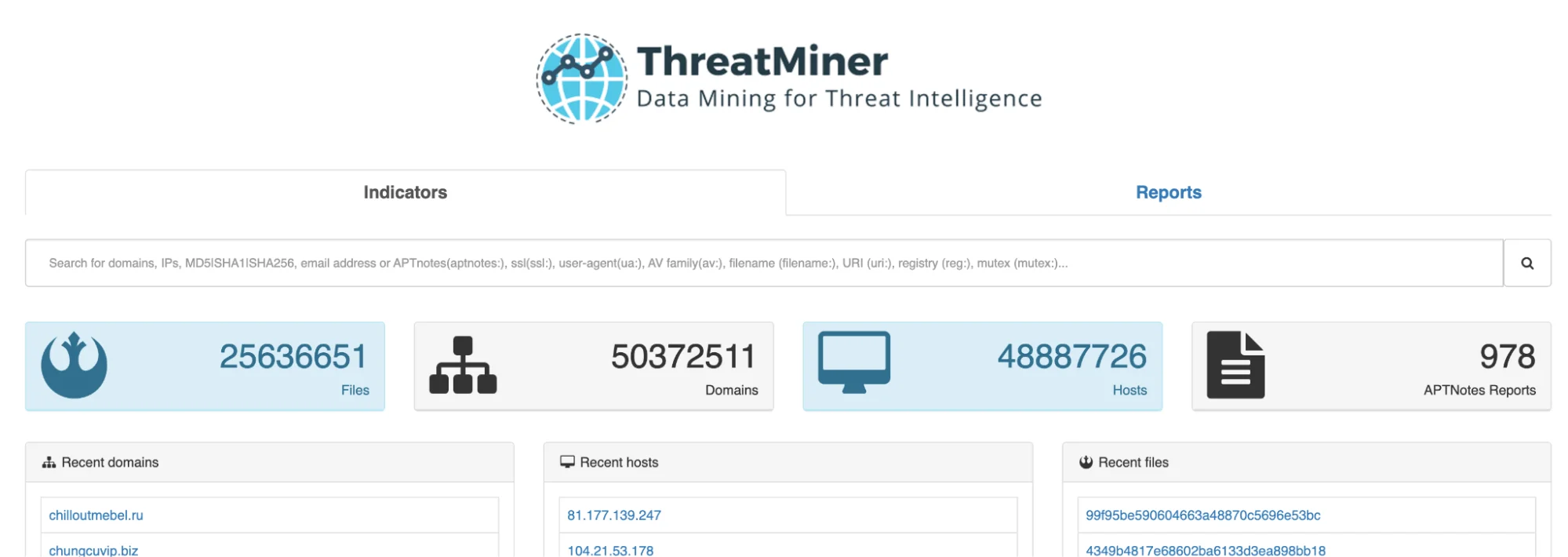
The main page of the ThreatMiner platform
Widely used in cybersecurity training and by professionals for threat enrichment and pivoting, ThreatMiner also offers API access. While there are no paid tiers, some usage limits may apply. Still, it is an accessible and valuable tool for individual analysts and small teams conducting open-source threat investigations.
5. IOC Radar by SOCRadar Labs
IOC Radar is a completely free tool from SOCRadar Labs that lets users search and explore a wide range of Indicators of Compromise with ease. It is designed to support quick lookups and enrichment, making it a useful resource for both junior analysts and experienced threat hunters.
The tool offers a clean interface and contextual information around domains, IPs, URLs, and hashes.
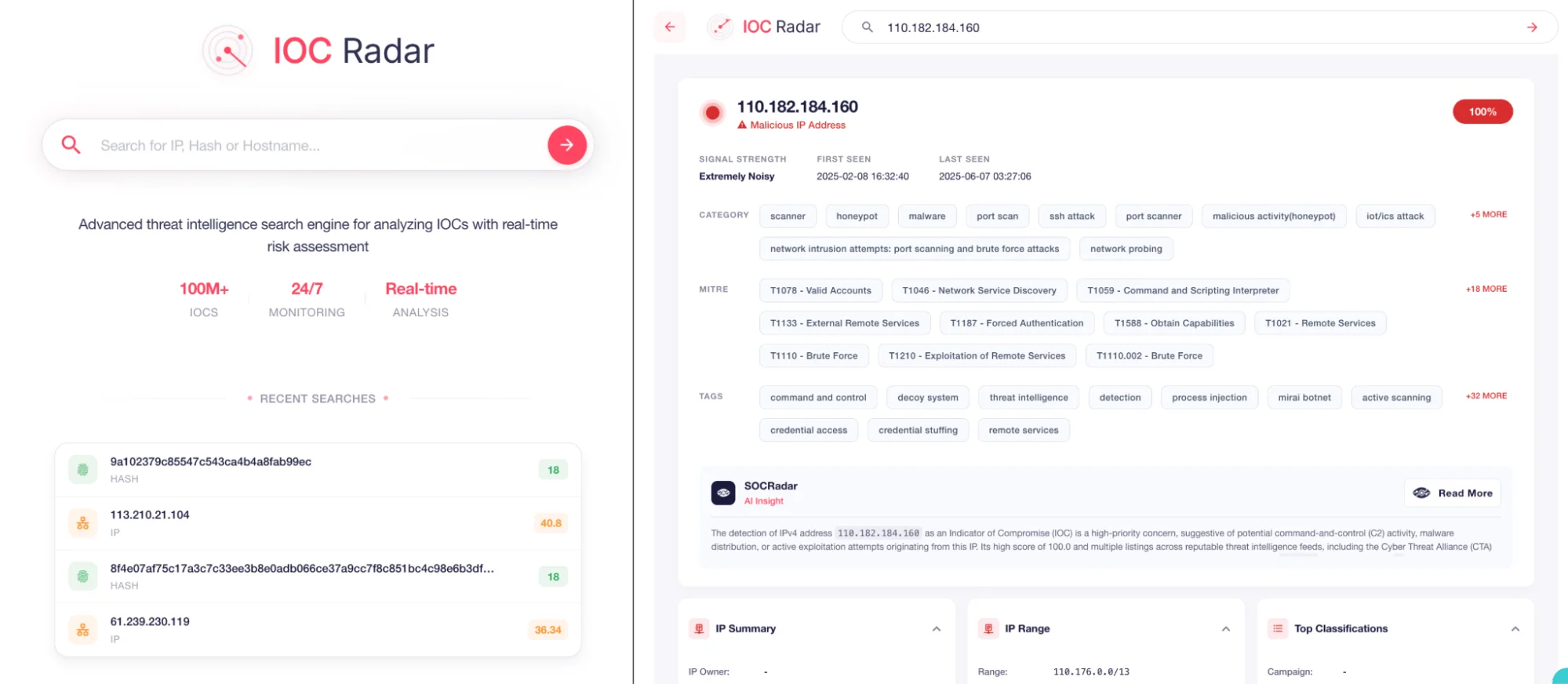
SOCRadar Labs’ IOC Radar search page & example results
It is also important to note that while it is a standalone tool, IOC Radar benefits from SOCRadar’s broader threat intelligence ecosystem, delivering enriched results even in the free version. No login or subscription is required to start using it.
6. ThreatFox & URLhaus (by abuse.ch)
abuse.ch provides standout free platforms for tracking malware infrastructure. In this blog, we will highlight ThreatFox and URLhaus. Both are community-driven and offer constantly updated IoCs to help analysts and defenders respond to active threats.
- ThreatFox focuses on malware-related indicators like domains, IPs, URLs, and file hashes. It allows users to share, search, and export threat data in multiple formats (CSV, JSON, MISP) and provides full API access for automation. The platform integrates with tools like ManageEngine Log360 and other SIEMs for enhanced detection. There are no usage restrictions, making it ideal for teams looking to build custom workflows around fresh threat data.
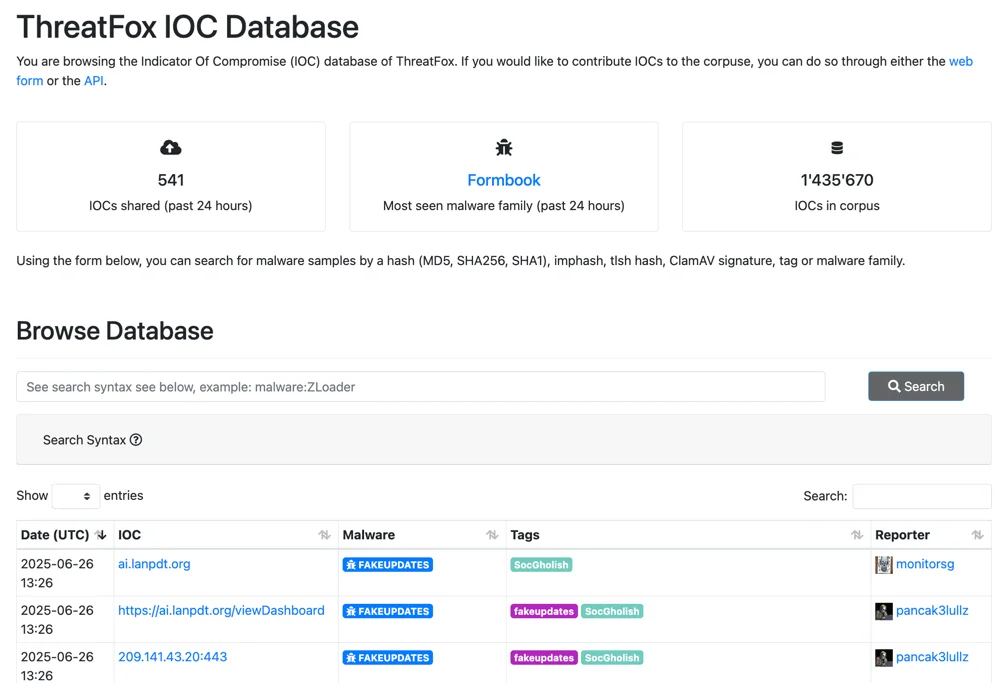
Search malware samples by hashes, signature, and tags with ThreatFox
- URLhaus specifically targets malicious URLs used in malware distribution. It helps defenders identify and block malware-hosting infrastructure before it causes damage. It offers rapid feed updates, downloadable CSV dumps every five minutes, and integration-ready blocklists for proactive defense. URLhaus also offers real-time DNS blocklists and Response Policy Zones (RPZs), making it useful for both email and network-level protection. Its API is open and free to use, with only minimal guidance to avoid overloading the service.
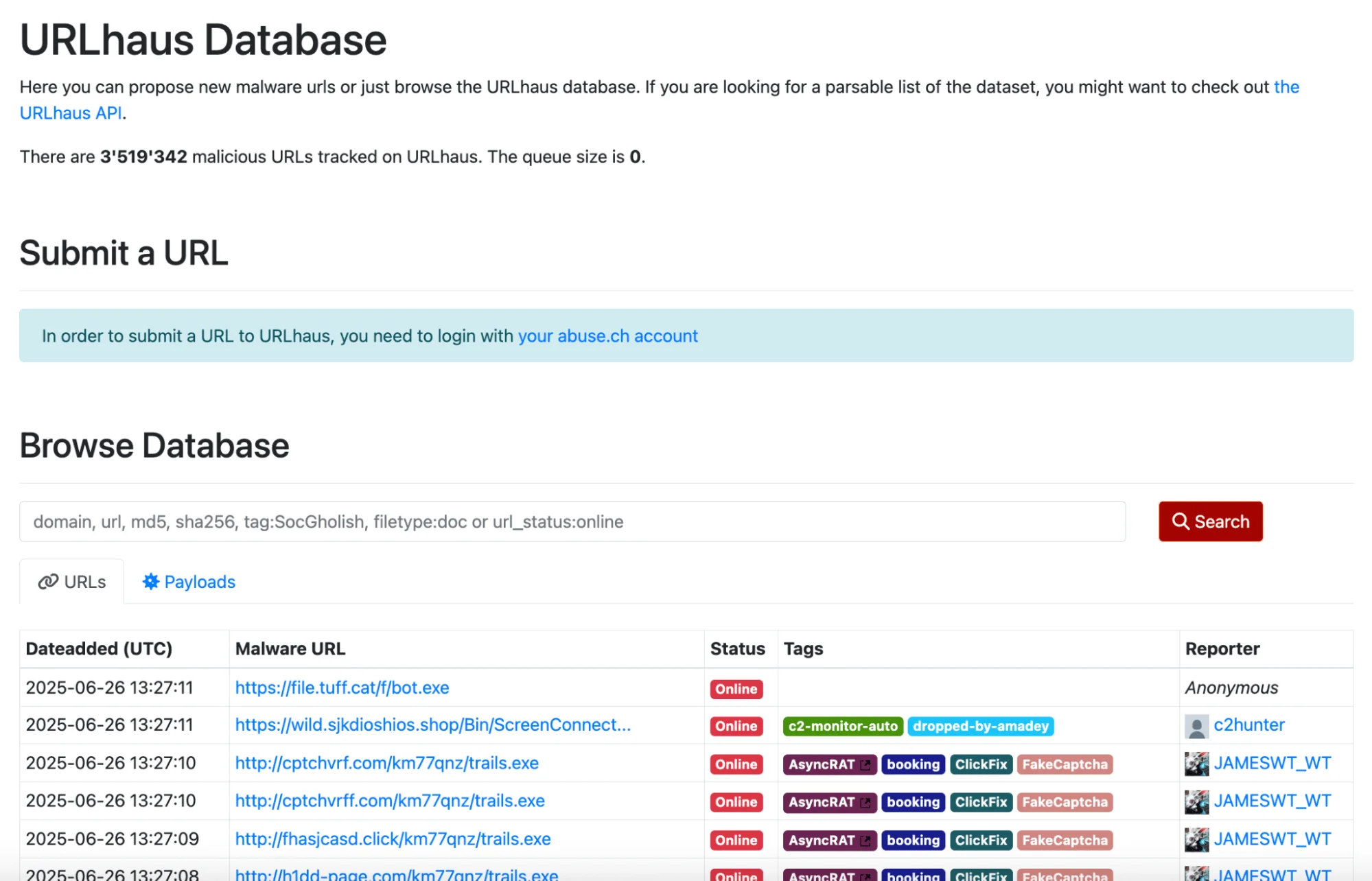
You can browse URLhaus database through the website or use the API for dataset lists
Both platforms are free to use and require no registration or API key for most functionality. They make a powerful duo for SOC teams, researchers, and network defenders looking for high-quality, actionable threat intelligence.

7. GreyNoise
As stated on their website, GreyNoise is dedicated to gathering, evaluating, and categorizing data concerning Internet Protocol (IP) addresses that engage in scanning activities across the web, inundating security systems with superfluous data. Mitigating the impact of noisy alerts, it categorizes them, which improves the effectiveness of the Security Operations Center (SOC) in identifying particular threats.
By labeling known “internet background noise,” GreyNoise reduces false positives and streamlines alert triage. It integrates with SIEM, SOAR, and threat intelligence platforms (TIP), offering valuable context for inbound connections or suspicious IPs.
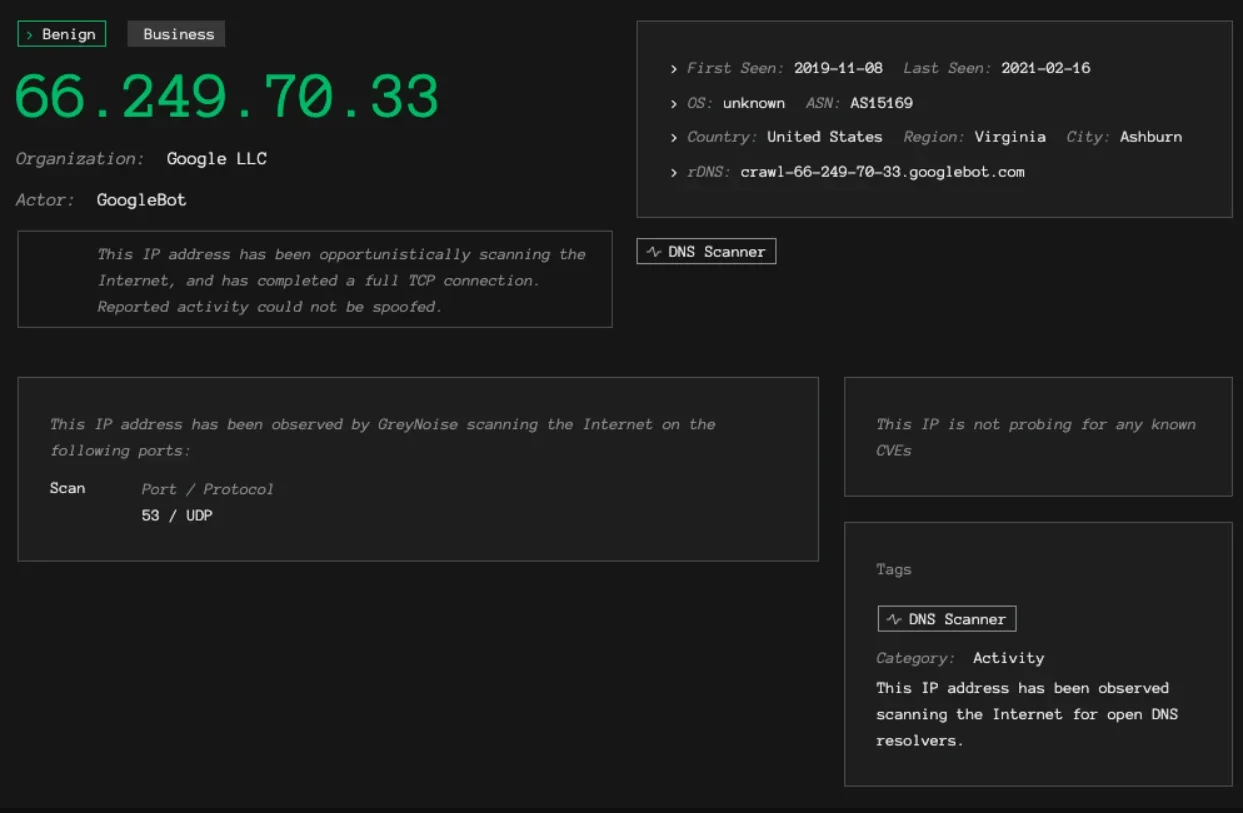
GreyNoise filters the noise, deprioritizing events originating from benign IPs and common business services to aid SOC teams.
The system essentially gives visibility into mass exploit activity targeting your attack surface. It helps create IP blocklists during exposure windows and allows teams to prioritize patching by filtering out known exploit traffic at the perimeter. This buys time for remediation. Moreover, it supports contextualization and automation of threat hunting endeavors by revealing attacker TTPs through rich telemetry. By leveraging IP metadata, GreyNoise strengthens and automates cyber investigations, improving operational efficiency.
The free Community API allows users to look up IP reputation data and metadata. While more advanced automation features are available commercially, the free tier remains useful for quick checks during investigations.
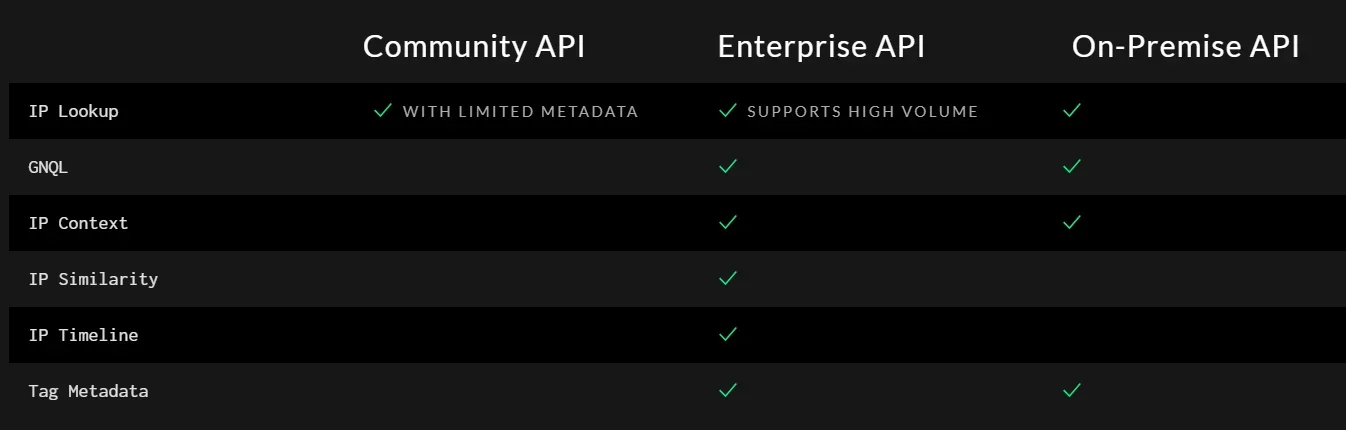
Community API only has IP Lookup feature
8. MISP Threat Sharing
MISP is an open-source threat intelligence platform built for enriching IoCs across a wide range of threats such as targeted attacks, financial fraud, vulnerabilities, and counter-terrorism. It is widely adopted by CERTs, SOCs, and threat research teams. We should also add that MISP also contributes to many of the platforms we write about here.
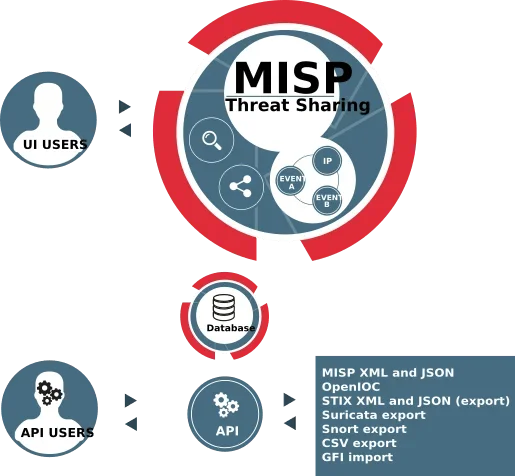
MISP Threat Sharing
Its key strengths lie in its ability to facilitate the sharing, storage, and correlation of IoCs related to cybersecurity, malware analysis, and beyond. It serves as an efficient IoC and indicators database, accommodating both technical and non-technical information about malware samples, incidents, attackers, and intelligence.
MISP’s automatic correlation engine links indicators and attributes from various sources, such as malware samples, attack campaigns, and analysis reports. Advanced techniques like fuzzy hashing (e.g., ssdeep) and CIDR block matching enhance its analytical capabilities.
Its flexible data model allows users to define and link complex threat objects, while built-in sharing features support multiple distribution models and synchronization between MISP instances. The platform also offers advanced filtering options to align with organizational sharing policies, including granular sharing group controls and attribute-level distribution mechanisms.
From a user perspective, MISP provides an intuitive interface for creating, updating, and collaborating on events, attributes, and indicators. Event graphs make it easy to explore relationships between indicators and contribute more effectively.
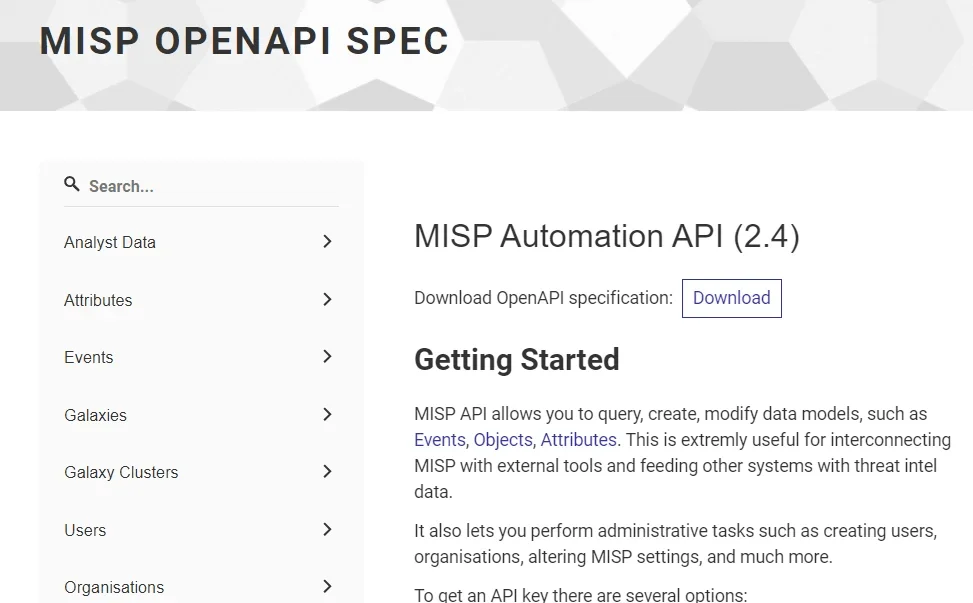
MISP supports a wide range of export formats, including IDS rules (Suricata, Snort, Bro), OpenIOC, plain text, CSV, and JSON, ensuring smooth integration with other security tools. It also allows bulk and free-text imports, making it compatible with external sources like GFI sandbox, ThreatConnect, and MISP feeds.
Its collaborative features include trust-group sharing, feed synchronization, and delegated access. PyMISP, the official Python library, enables custom integrations and automation.
The platform’s source code, along with documentation and install scripts, is available on GitHub.
9. VirusTotal
VirusTotal is best known as a multi-engine malware scanning service, but it also offers strong IoC enrichment capabilities through its web interface and API. It aggregates results from antivirus engines, behavioral analysis tools, and partner feeds, including SOCRadar, to provide deep insights into files, domains, URLs, and IPs.
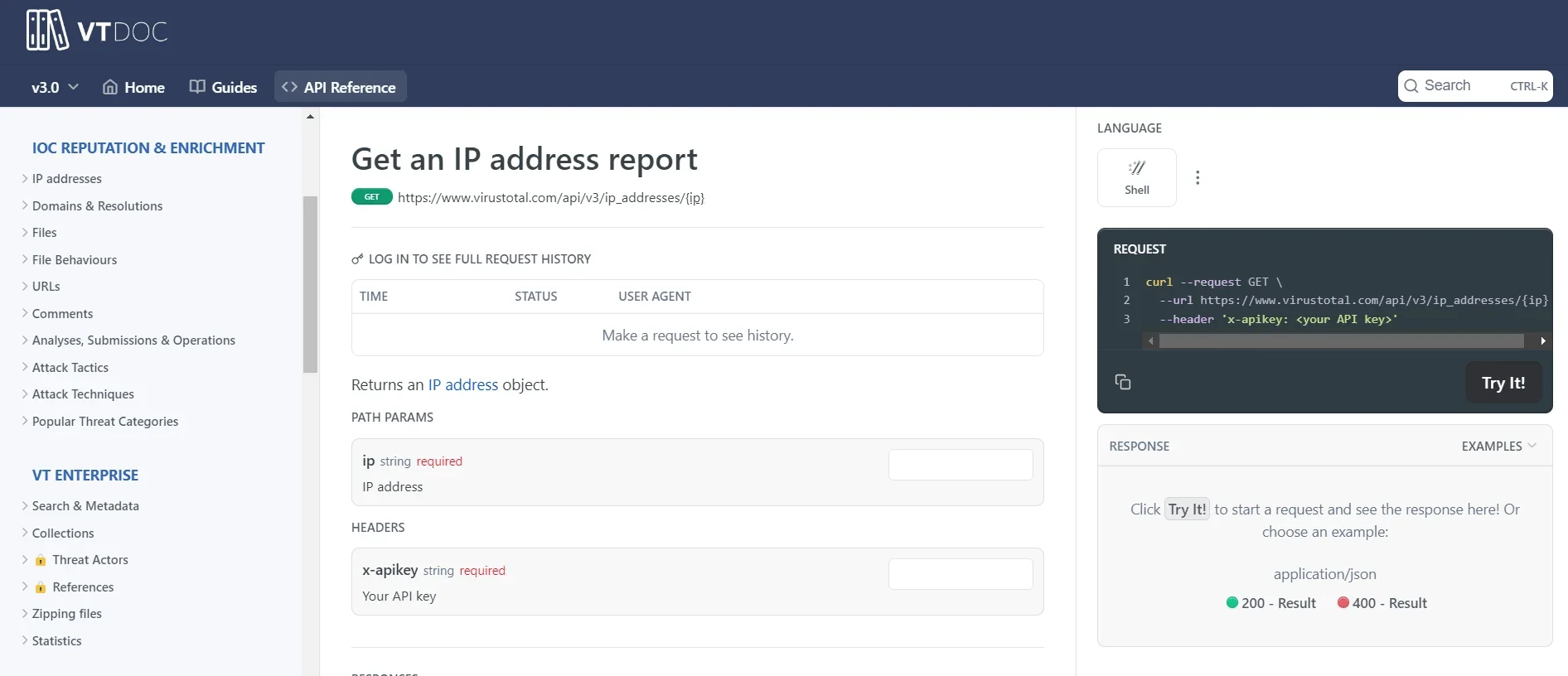
VirusTotal has a very detailed documentation for its API
The VirusTotal API facilitates file or URL uploads and scans, grants access to completed scan reports, and enables automated comments without reliance on the website interface. Essentially, it empowers the creation of straightforward scripts for accessing all of VirusTotal’s generated information.
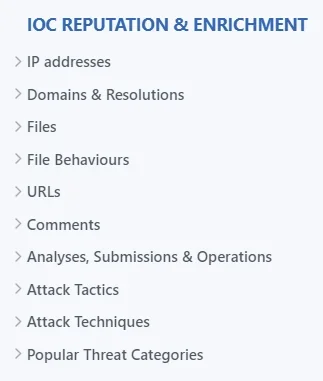
VirusTotal documents about IoC Reputation & Enrichment
VirusTotal integrates well with SIEMs and other security platforms, helping analysts validate alerts and prioritize response efforts. When a security alert surfaces, VirusTotal enhances it by furnishing critical threat data such as detections, attributes, associations, behaviors, and more.
10. ThreatBook
ThreatBook provides cybersecurity threat intelligence with a focus on speed, accuracy, and actionable data. Its platform is known for real-time assessments of IPs, domains, and file samples, often sourced from real-world incidents.
With a focus on accurately identifying compromised hosts and emerging threats like mining pools and ransomware, they enable rapid response strategies and effective risk mitigation.
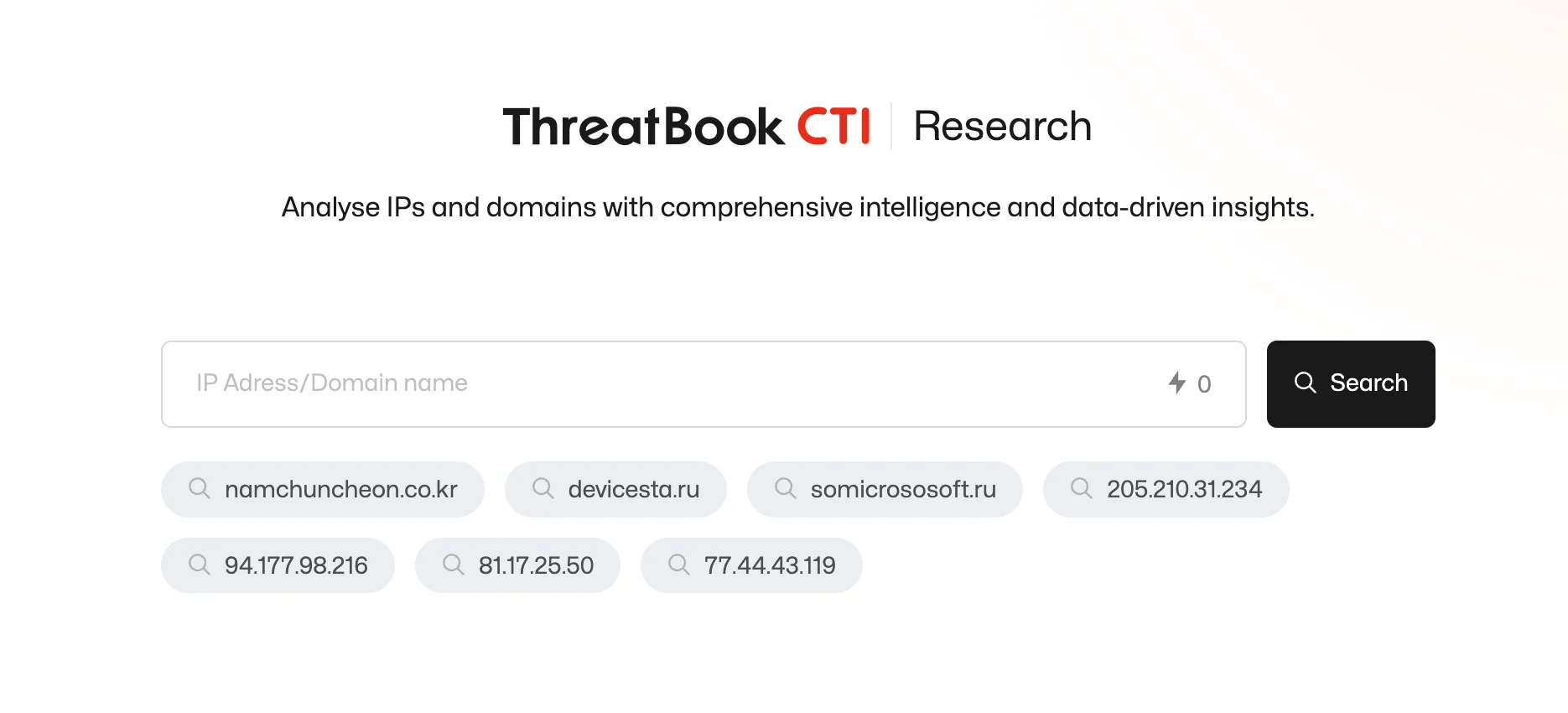
ThreatBook Intelligence’s main page
While full platform access requires a paid subscription, the free community API supports IP lookups. The IP reports encompass comprehensive intelligence assessments, including C2, Malware, Zombie, Compromised Host, Scanner, and more, along with contextual details such as open ports, certificates, and additional relevant information.
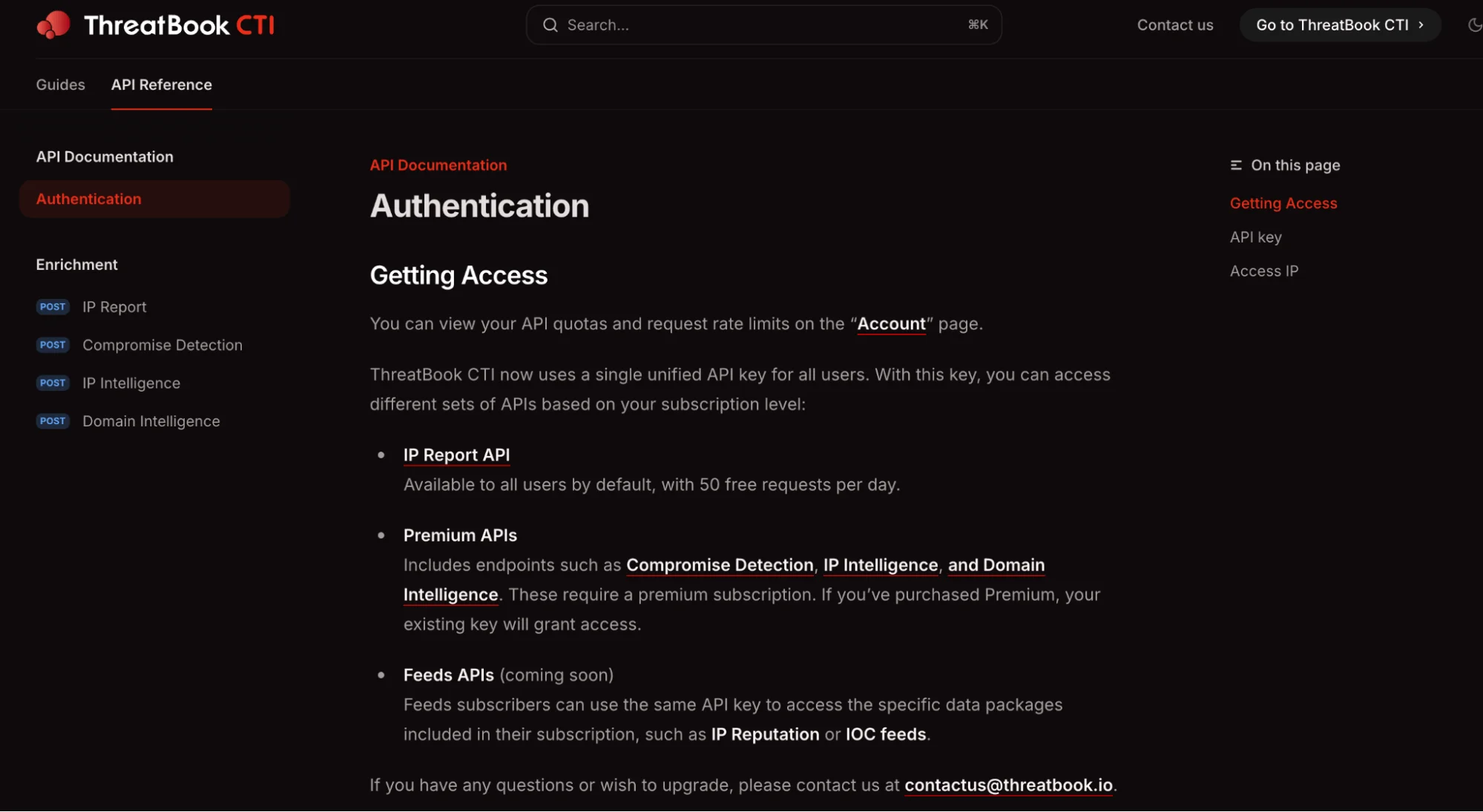
ThreatBook’s Community API only has IP Report function
ThreatBook also integrates with other security tools, enabling faster triage and response during investigations. Its real-world grounding and focus on high-confidence alerts make it a valuable addition to any analyst’s toolkit.
Other Notable Platforms with Free Access
While not entirely free, a few well-known commercial platforms offer limited functionality at no cost, useful for analysts seeking deeper context or trying out premium features.
IBM X-Force Exchange
IBM’s threat intelligence platform provides searchable IoC data, threat actor profiles, and vulnerability insights. The standard API offers categorized feeds and reports, with a 30-day free trial available for more advanced usage.
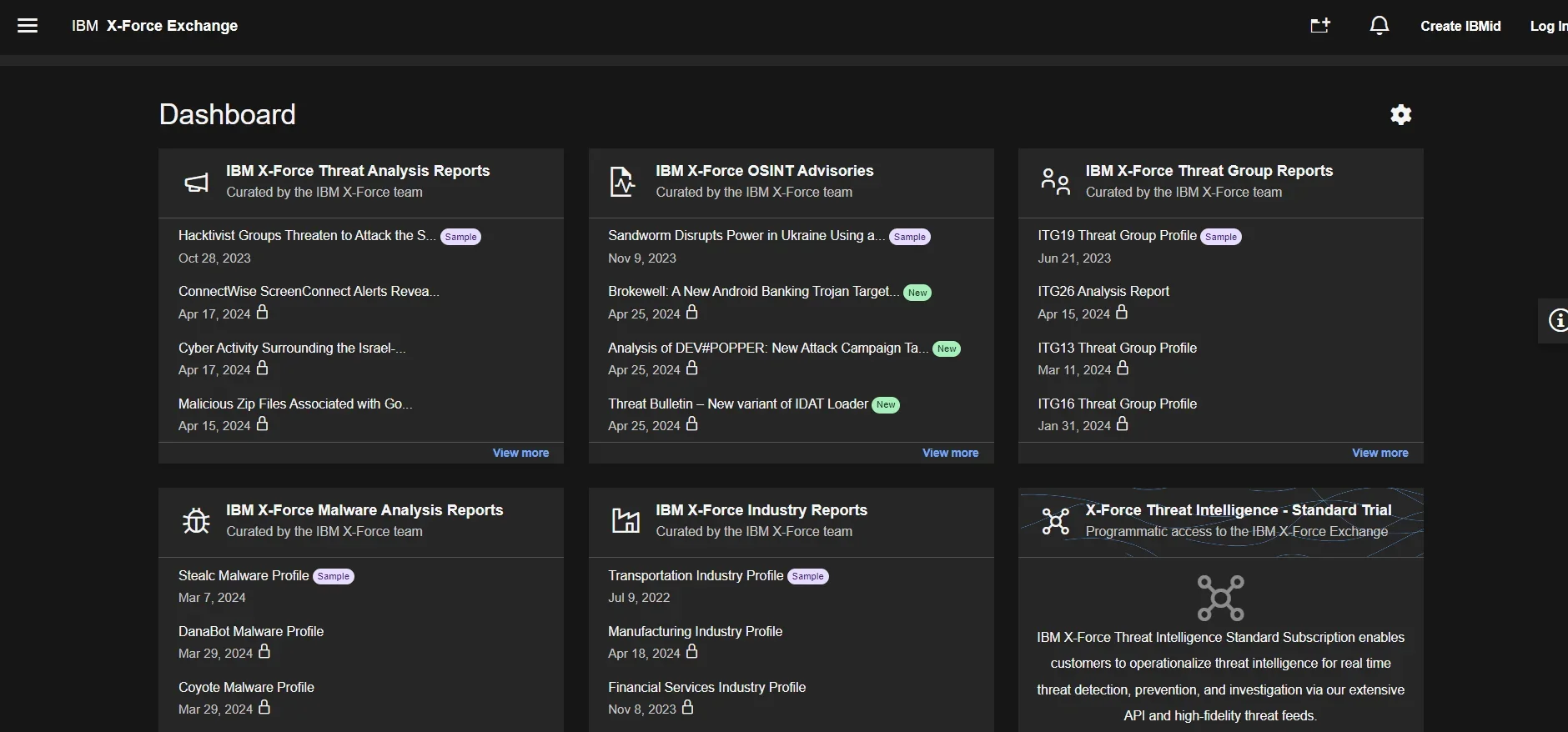
IBM X-Force Exchange
The IBM X-Force Threat Intelligence API enables users to automate the retrieval of threat intelligence data from IBM X-Force Exchange, which is IBM’s cloud-based platform for sharing threat intelligence. This API grants access to categorized IP and URL feeds, detailed IP and URL reports, vulnerability feeds, and all TAXII feeds.
RST Cloud
RST Cloud aggregates threat data from sandboxes, honeypots, and open sources. It supports enrichment, threat actor tracking, and integration with tools like MISP and SIEMs. Although a free trial is available, most core features are gated behind a paid tier.
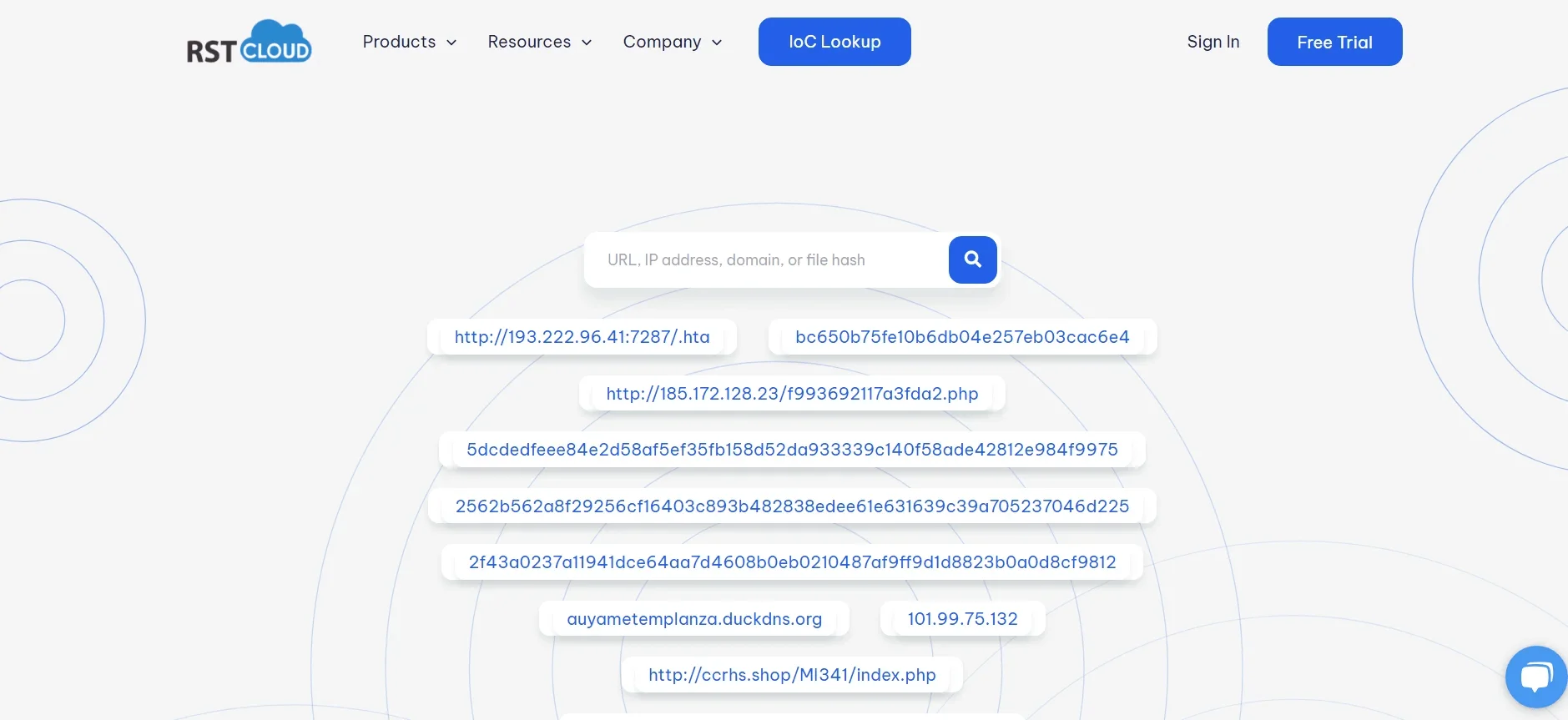
RST Cloud IoC Lookup
Bonus: SOCRadar Threat Feed & IoC Module
The ability to search, enrich, and act on Indicators of Compromise is essential for defenders at every level, from SOC analysts to incident responders. While many platforms offer threat intelligence, the tools featured in this list stand out for being free, reliable, and actively maintained.
In addition to our free IOC Radar tool covered earlier, SOCRadar offers a more advanced Threat Feed & IoC module as part of its broader threat intelligence platform. Designed for cybersecurity teams who need enriched, up-to-date data at scale, this module enhances detection and response efforts across multiple threat surfaces.
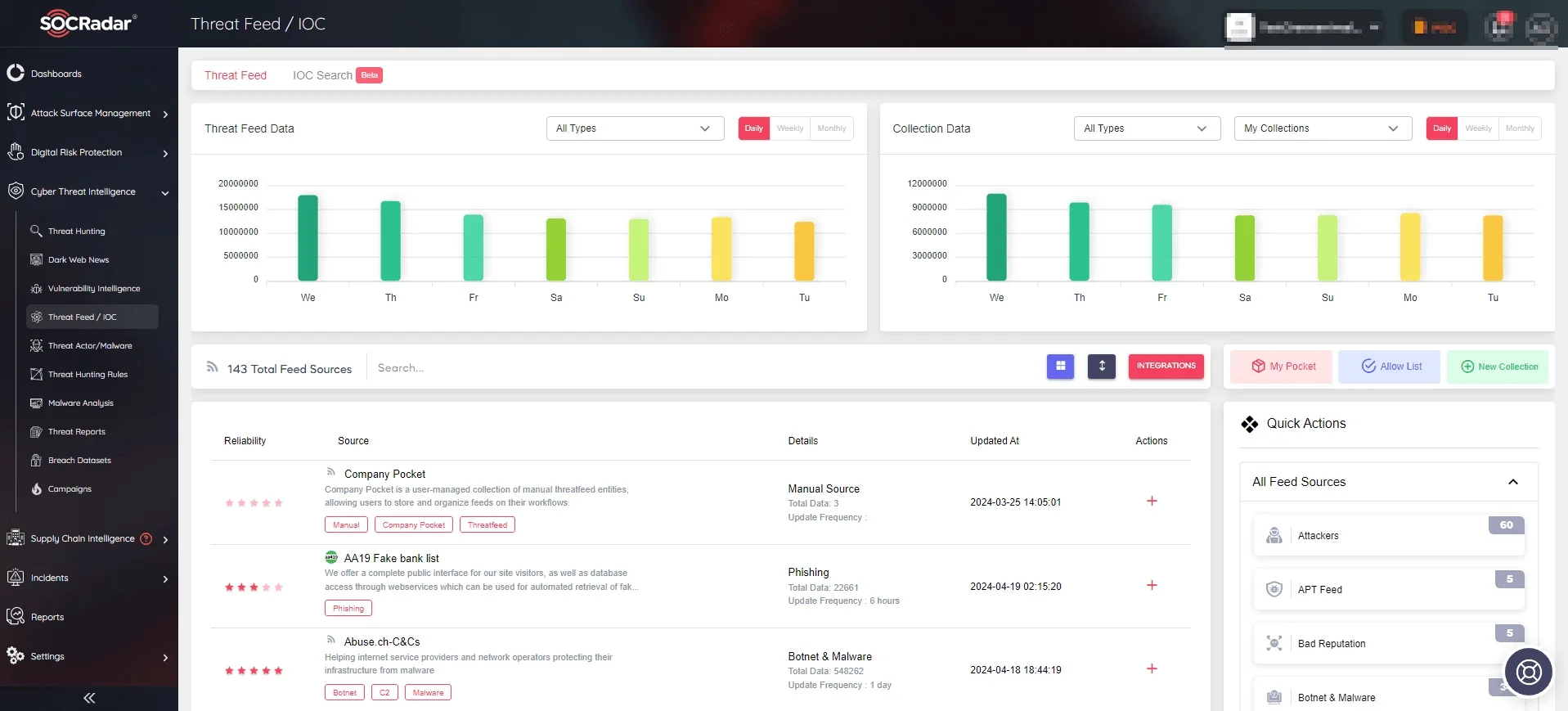
SOCRadar’s Threat Feed & IoC Management module
Key capabilities include:
- Customizable threat feeds tailored to your organization’s risk profile
- Bulk IoC search with contextual data for fast investigations
- Seamless integration with SIEMs and TIPs via TAXII support
- Actionable intelligence drawn from SOCRadar’s Dark Web Monitoring, vulnerability feeds, and global telemetry
SOCRadar’s platform transforms massive volumes of threat data into operational insights, helping teams act quickly against evolving threats. For those seeking to scale threat intelligence workflows or expand IoC analysis, this module offers deep visibility and automation options.



